
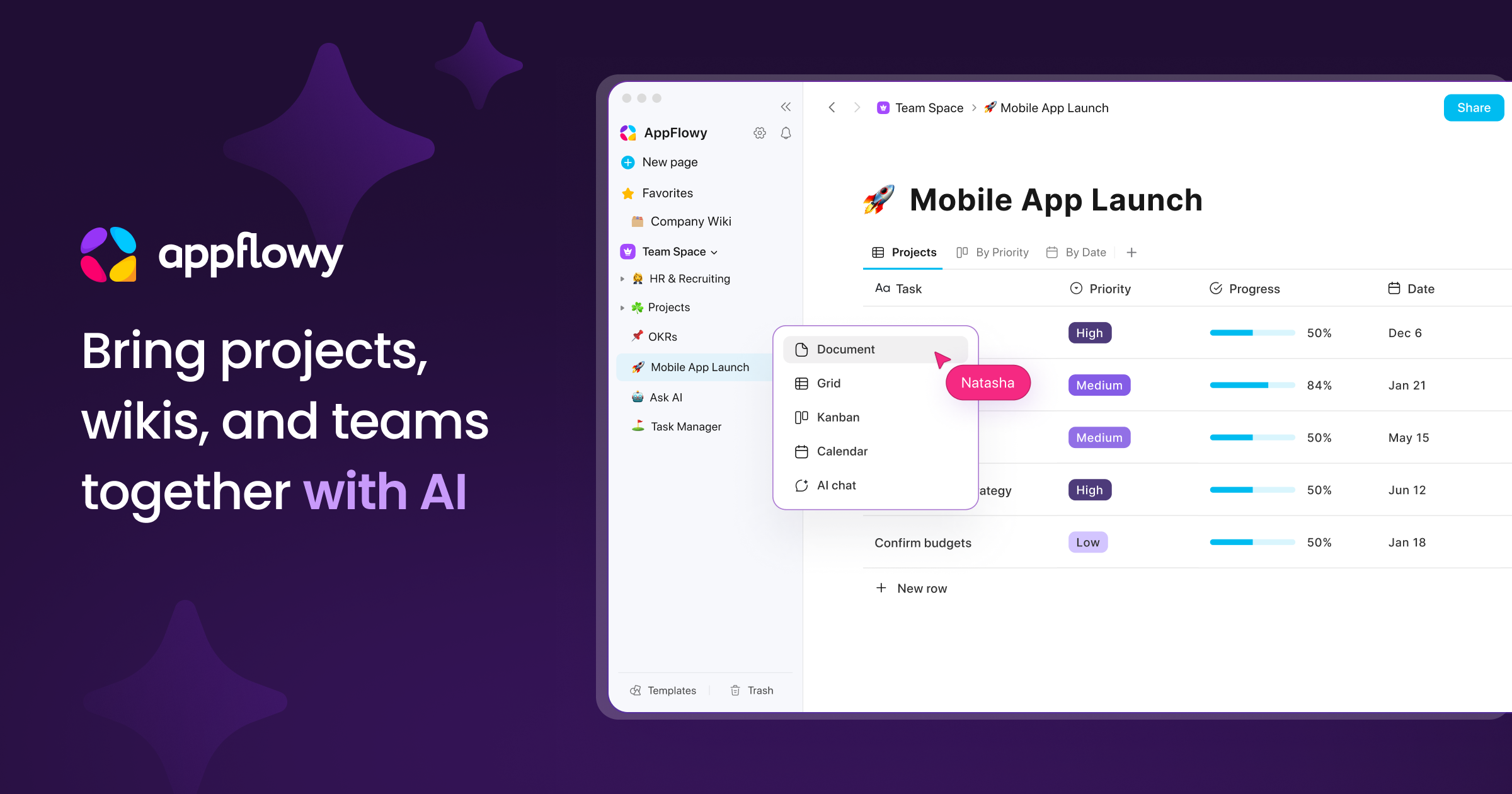
Getting AppFlowy Cloud running on your own server is not the weekend project the docs suggest. The Docker Compose stack pulls in PostgreSQL, MinIO, and a NATS message broker, and every minor release ships schema migrations that can strand a self-hosted instance if you skip a step. That is the point where a lot of teams start looking at AppFlowy alternatives that give you the same Notion-style workspace with a lighter footprint or a cleaner sync story. We tested seven of them on Windows, macOS, and Linux desktop.
This roundup is for people who already know why they want to leave Notion behind: local files, open licenses, no per-seat pricing. AppFlowy answers most of that brief, but it is not the only answer, and for some workflows it is not the right one.
Quick comparison
| App | Best for | Free plan | Starting price/mo | Standout feature |
|---|---|---|---|---|
| AFFiNE | Visual thinkers and mind-mappers | Full local app free | $6.75/user (cloud team) | Edgeless whiteboard mode |
| SiYuan | Personal knowledge management | Full local app free | About $8/mo (cloud sync) | Built-in flashcards and OCR |
| Anytype | Zero-cloud workspace | Free for personal | About $99/year (Any Team) | Peer-to-peer end-to-end encryption |
| Focalboard | Mattermost-adjacent teams | Free, self-hosted | Bundled with Mattermost | Kanban-first data views |
| Outline | Team documentation wikis | Free self-host | $10/user (cloud) | Slack and GitHub integrations |
| Docmost | Startup wikis on a budget | Free self-host | About $5/user (cloud) | Real-time collaboration and diagrams |
| Notesnook | Encrypted personal notes | 3 devices, unlimited notes | About $4.99 (Pro) | End-to-end encryption by default |
Why people leave AppFlowy
Users on GitHub Discussions keep raising the same short list of grievances. Self-hosting AppFlowy Cloud is not trivial: the Docker Compose stack pulls in PostgreSQL, MinIO, and a NATS server, and upgrade migrations have a reputation for breaking on minor version bumps. Contributors have logged threads about database dumps and manual patches after botched updates, which is not the workflow anyone signed up for.
Feature parity with Notion also still trails on databases. Rollups, formulas, and linked views only landed in late 2025, and some of those views still behave inconsistently between the desktop and mobile apps. If you moved to AppFlowy for the Notion-shaped data model, that gap will show up early.
The AI features are the third sore point. When you use the hosted version, AI is gated behind a paid tier even though the underlying code is open source. Self-hosting the AI stack means wiring up your own model provider, which many teams are not staffed to do.
Mobile clients are the fourth. The Flutter apps lag desktop in stability, particularly the sync layer, and users regularly report conflicts after editing the same doc on two devices.
The 7 alternatives
AFFiNE: best overall workspace
AFFiNE merges documents, whiteboards, and databases into one MIT-licensed workspace. Its Edgeless Mode turns any doc into a spatial canvas where paragraphs, images, and cards become movable elements, which is the closest thing to Miro plus Notion in a single window. AFFiNE vs AppFlowy comes down to whether you sketch and connect ideas visually or write them in linear pages. You can self-host with Docker Compose on a small VPS.
Where it falls short: the sync server is heavier to self-host than AppFlowy’s. You need Postgres, Redis, and the AFFiNE GraphQL service, plus a reverse proxy for TLS.
Pricing:
- Free: full desktop app with local storage and unlimited docs
- Paid: cloud plan around $6.75 per user per month for teams
- vs AppFlowy: similar free ceiling, cloud tier costs about the same
Migrating from AppFlowy: no direct importer. Export AppFlowy pages to Markdown and drop the folder into AFFiNE. Tables and embeds need manual cleanup, and a 200-page workspace takes about half a day.
Download: affine.pro · GitHub
Bottom line: pick AFFiNE if your team mind-maps more than it documents. Skip it if you need a lightweight sync setup.
SiYuan: best for personal knowledge management
SiYuan is a local-first, block-based knowledge manager with flashcards, OCR, database views, and built-in AI. Your data lives as plain files on disk, so backup and sync are your call, with an optional cloud sync tier if you want the app to handle it. SiYuan vs AppFlowy is the classic single-user versus workspace split.
Where it falls short: the UI is dense and the community docs are still catching up in English. New users spend the first hour hunting for settings that live inside nested menus.
Pricing:
- Free: full desktop app, local files, unlimited notes
- Paid: cloud sync tier at roughly $8 per month
- vs AppFlowy: cheaper than AppFlowy Cloud, but only for solo use
Migrating from AppFlowy: import Markdown folders directly. Databases do not carry over cleanly, so plan to rebuild those by hand.
Download: b3log.org/siyuan · GitHub
Bottom line: pick SiYuan if you learn by spaced repetition and want your notes to double as flashcards. Skip it if you need a shared team space.
Anytype: best for zero-cloud workflows
Anytype is a decentralized, local-first workspace with end-to-end encryption and peer-to-peer sync. There is no central server involved, and the object-graph model replaces pages with typed objects that link to each other. Anytype vs AppFlowy is the more radical rethink of the workspace idea: same feature ambition, different mental model.
Where it falls short: the onboarding curve is steep and the model differs from Notion enough that some imports feel awkward. Expect a week before it clicks.
Pricing:
- Free: full app for personal use
- Paid: Any Team plan at about $99 per year per organization
- vs AppFlowy: cheaper for individuals, comparable for small teams
Migrating from AppFlowy: no direct importer. Export to Markdown, then use Anytype’s Markdown importer. Types and relations need to be defined by hand afterwards.
Download: anytype.io · GitHub
Bottom line: pick Anytype if you want the Notion feature set without any cloud dependency. Skip it if you cannot afford a week of ramp-up time.
Focalboard: best for Mattermost teams
Focalboard is the kanban and project-tracking flavour of the Notion clone, from the Mattermost team. It is MIT-licensed and self-hosted with Docker, and if your team already runs Mattermost it plugs into the same server. Focalboard vs AppFlowy is really a project board versus workspace comparison, not a like-for-like swap.
Where it falls short: the personal-desktop client was deprecated in 2024. You now need the server component running to use it, which is a change from the earlier standalone builds.
Pricing:
- Free: server is free and open source
- Paid: bundled with Mattermost paid tiers when you need SSO or compliance
- vs AppFlowy: cheaper to run when you already host Mattermost
Migrating from AppFlowy: no importer. Boards get rebuilt by hand, and card data can be pasted from CSV.
Download: focalboard.com · GitHub
Bottom line: pick Focalboard if you already live inside Mattermost. Skip it if you want a general workspace rather than a project board.
Outline: best for engineering team wikis
Outline is a team wiki that reads and writes like Notion but focuses on documentation. It is self-hostable under the BSL license, and the cloud plan starts around $10 per user per month. Slack, GitHub, and Figma integrations ship out of the box, which is why documentation-heavy engineering teams tend to pick it. Outline vs AppFlowy is docs-first versus workspace-first.
Where it falls short: it is not a general workspace. There are no databases, no kanban, and no calendar views.
Pricing:
- Free: self-hosted under BSL
- Paid: cloud plan from $10 per user per month
- vs AppFlowy: pricier per seat on cloud, but with turnkey SSO
Migrating from AppFlowy: import Markdown or HTML per page. Nested pages hold their structure. Databases do not exist on the Outline side and will not carry over.
Download: getoutline.com · GitHub
Bottom line: pick Outline if you are building an internal handbook and want polished search. Skip it if you also need boards or databases.
Docmost: best budget wiki for startups
Docmost is a newer open-source wiki with real-time collaboration, page tags, and a built-in diagram editor. It is AGPL-licensed with a paid cloud option, and the self-host path is a single Docker Compose file. Docmost vs AppFlowy is the docs-focused, lighter-weight route through the same territory.
Where it falls short: it is still young. Some Notion-familiar features like databases and calendar views are on the roadmap rather than shipped.
Pricing:
- Free: self-host with Docker
- Paid: cloud plan from about $5 per user per month
- vs AppFlowy: cheaper cloud, similar self-host effort
Migrating from AppFlowy: Markdown import works page by page. Diagrams need to be rebuilt inside Docmost’s own editor.
Download: docmost.com · GitHub
Bottom line: pick Docmost if you want polished docs without paying per seat. Skip it if databases are non-negotiable.
Notesnook: best for encrypted personal notes
Notesnook is an encrypted personal notes app with sync across devices and Markdown export. The free tier gives you unlimited notes and up to 3 devices, and Pro at around $4.99 per month unlocks unlimited devices, larger attachments, and vault features. It is GPLv3-licensed, so the desktop client and server code are both open. Notesnook vs AppFlowy is the encryption-first counterpoint to the workspace pitch.
Where it falls short: it is not really a workspace. There are no databases, no kanban, and no team collaboration features.
Pricing:
- Free: unlimited notes on up to 3 devices
- Paid: Pro at about $4.99 per month
- vs AppFlowy: cheaper for individuals, but narrower in scope
Migrating from AppFlowy: import Markdown notes one folder at a time. Attachments transfer if you keep the folder structure intact.
Download: notesnook.com · GitHub
Bottom line: pick Notesnook if you want end-to-end encryption on your notes by default. Skip it if you need any team feature at all.
How to choose
Pick AFFiNE if your team thinks in whiteboards and needs a real spatial canvas alongside written docs. It is the closest one-for-one workspace swap for AppFlowy, and the license terms are as generous.
Pick SiYuan if you are a solo user who runs a personal knowledge base and wants flashcards, OCR, and databases in one app. The learning curve is real, but it pays back within a week.
Pick Anytype if the whole reason you are leaving Notion or AppFlowy is that you do not want any central server involved. Peer-to-peer sync with end-to-end encryption is not something the other options in this list match.
Pick Focalboard if your team already runs Mattermost and you just need a project board that lives on the same server. It is the cheapest option to bolt on.
Pick Outline or Docmost if the workload is mostly documentation. Outline gives you polished search and enterprise integrations; Docmost gives you a lower price and a lighter self-host stack.
Pick Notesnook if you are one person, your data is sensitive, and encryption is the top requirement. It is the wrong tool for anything collaborative.
Stay on AppFlowy if the self-hosting complexity is worth it for your workflow, and if you depend on the specific database and kanban combination that only ships in the latest desktop releases.
FAQ
Is AFFiNE better than AppFlowy?
For visual and spatial thinkers, yes. AFFiNE’s Edgeless Mode is the closest thing to a real infinite canvas inside a Notion-style workspace, and its MIT license matches AppFlowy’s openness. For teams that write more than they diagram, AppFlowy still holds its own.
Can I import my data from AppFlowy to another app?
Partially. Every alternative on this list accepts Markdown, and AppFlowy can export pages to Markdown, so document text and structure move cleanly. Databases, embedded views, and custom fields usually do not, and you should plan to rebuild those in the new app.
What is the cheapest AppFlowy alternative?
Docmost self-hosted is the cheapest team option, because the Docker Compose stack is smaller than AppFlowy’s and the cloud plan starts around $5 per user per month. For solo users, Notesnook’s free tier and SiYuan’s local app cost nothing at all.
Is there a self-hosted AppFlowy alternative?
Yes: AFFiNE, SiYuan, Anytype, Focalboard, Outline, and Docmost all self-host. Anytype is the outlier because it uses peer-to-peer sync rather than a central server, so self-hosting Anytype means running a personal sync node rather than a traditional web service.
What do people use instead of AppFlowy?
The most common swaps in open-source discussions right now are AFFiNE for workspaces, SiYuan for personal knowledge management, Outline for engineering wikis, and Anytype for zero-cloud setups. Docmost is the newer entrant that keeps showing up in cost-driven comparisons.
